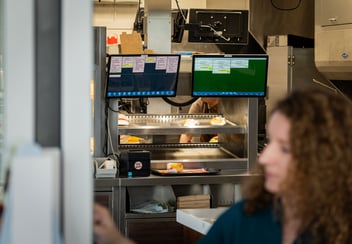

A smart kitchen is a commercial kitchen that uses connected devices, IoT sensors, automation, and software platforms to monitor and optimize food preparation, inventory, and equipment performance in real time. Instead of relying on manual tracking, orders flow digitally through seamless POS integration directly to a Kitchen Display System (KDS), while smart appliances and sensors automatically track temperature compliance, energy monitoring, and stock levels. Ultimately, the goal is to transform back-of-house (BOH) operations from a reactive workspace into a highly efficient, data-driven kitchen that effortlessly supports the scalability of any multi-unit chain.
By connecting digital channels, kiosks, and aggregators into a unified cloud-based kitchen management system like Ordering Stack, restaurant chains can optimize order routing, drastically reduce ticket time, and improve food safety automation with full HACCP compliance. Utilizing smart appliances, real-time monitoring, and demand forecasting allows operators to cut labor costs, prevent food waste, and maximize equipment uptime to achieve a rapid return on investment.
What you'll learn in this article:
- What a smart kitchen is and which technologies define it.
- The core benefits: efficiency, cost savings, food safety, and sustainability.
- Real-world data on the ROI of smart kitchen technology.
- The main components needed to build one.
- How Ordering Stack's Kitchen Display System fits into a smart kitchen setup.
What Technologies Make Up a Smart Kitchen?
The foundation of a smart kitchen relies on a network of interconnected systems and devices working together seamlessly. At the core, IoT-connected appliances, such as smart appliances like automated ovens, fryers, and refrigerators, are equipped with sensors for real-time monitoring. This allows operators to track temperature compliance automatically, ensuring strict food safety automation and effortless HACCP compliance. Predictive maintenance sensors attached to this automated cooking equipment constantly monitor performance, providing remote diagnostics to alert staff before a breakdown occurs, thereby maximizing equipment uptime.
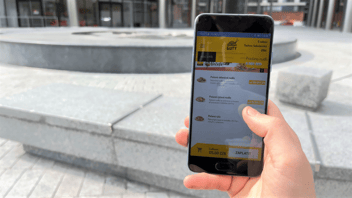
Another critical component is the Kitchen Display System (KDS), which replaces inefficient paper tickets. Through robust POS integration, a platform like Ordering Stack ensures flawless order routing from self-service kiosks, mobile apps, and aggregators directly to the connected kitchen screens. This digital workflow reduces ticket time and boosts operational efficiency for any multi-unit chain. Behind the scenes, inventory management software provides real-time stock tracking, working in tandem with AI-powered forecasting and demand forecasting tools to predict needs accurately. This integration of real-time data and automated workflows is the key to minimizing food waste and maximizing labor cost reduction. Finally, integrated energy monitoring systems help manage consumption, contributing to overall sustainability in foodservice and ensuring a stronger return on investment (ROI) within a fully data-driven kitchen.
Key Benefits of a Smart Kitchen
Transitioning to a connected kitchen unlocks a wide array of advantages that directly impact the bottom line and streamline BOH operations. By utilizing cloud-based kitchen management tools, operators can transform their workflows into a highly efficient, data-driven kitchen capable of meeting the demands of modern foodservice.
- Increased efficiency and faster ticket times: With seamless POS integration and automated order routing to a Kitchen Display System (KDS), orders from kiosks, mobile apps, and aggregators are instantly visible to the kitchen staff. This eliminates manual ticket handling, optimizes workflow, and drastically reduces ticket time, which is especially crucial for high-volume, multi-unit chains.
- Reduced food waste through better inventory visibility: By utilizing advanced inventory management software and AI-powered forecasting, restaurants can implement precise demand forecasting. This ensures that purchasing aligns perfectly with actual consumption, leading to significant food waste reduction and optimized stock levels.
- Lower energy costs via optimized equipment usage: Implementing energy monitoring systems across smart appliances allows operators to track and manage utility consumption in real time. This not only lowers operational expenses but also promotes greater sustainability in foodservice.
- Improved food safety through automated temperature/compliance monitoring: IoT sensors provide continuous real-time monitoring of refrigerators and automated cooking equipment. This food safety automation guarantees strict temperature compliance and simplifies HACCP compliance by eliminating human error from manual logging.
- Greater consistency in food quality across multiple locations: Using robotic kitchen stations and automated workflows ensures that every meal is prepared to the exact same standard, regardless of the location. This level of control, combined with remote diagnostics to maintain maximum equipment uptime, guarantees a reliable customer experience and a strong return on investment (ROI).
The Real ROI of Smart Kitchen Technology
Investing in a connected kitchen is more than just a technological upgrade; it is a strategic business decision with measurable financial outcomes. For any multi-unit chain, the transition to a data-driven kitchen supported by an omnichannel platform like Ordering Stack provides a clear, quantifiable return on investment (ROI). By digitizing BOH operations and leveraging cloud-based kitchen management, restaurant operators can transform theoretical benefits into concrete, bottom-line savings.
Facilities utilizing automated cooking equipment and robotic kitchen stations report up to a 30% reduction in overall operational costs. Furthermore, implementing IoT sensors for active energy monitoring can yield 10 to 15% energy savings compared to relying on traditional appliances, directly improving sustainability in foodservice.
When it comes to human resources and workflow, the automation of repetitive tasks leads to a 20% labor cost reduction. On the service side, replacing paper workflows with a Kitchen Display System (KDS) powered by seamless POS integration and intelligent order routing results in 15 to 25% faster ticket times within the very first month of implementation. Inventory management also sees massive improvements. Utilizing AI-powered forecasting and modern inventory management software can drive a 31% reduction in over-ordering. This direct food waste reduction translates to roughly $18,000 to $45,000 in annual savings for a restaurant generating $1 million to $2 million in revenue. Depending on the scalability and scope of the technology deployed, the typical ROI window for these smart infrastructure upgrades ranges from 18 to 36 months.
To clearly outline the financial advantages, the following table breaks down the key performance improvements typically observed in a fully integrated commercial kitchen setup.
|
Metric |
Reported Improvement |
Source Type |
|
Operational Costs |
30% reduction via smart cooking equipment and automation |
Industry Benchmark |
|
Energy Efficiency |
10–15% energy savings compared to traditional appliances |
Equipment Manufacturers |
|
Labor Optimization |
20% labor cost reduction from automating repetitive tasks |
Restaurant Case Studies |
|
Service Speed |
15–25% faster ticket time in the first month of KDS use |
KDS & POS Integrators |
|
Waste Management |
31% reduction in over-ordering (18k–45k annual savings) |
AI Forecasting Analytics |
|
Overall Investment |
18–36 months typical ROI window |
Financial Projections |
Smart Kitchen vs. Traditional Kitchen: What's the Difference?
The leap from a standard setup to a connected kitchen fundamentally changes how back-of-house (BOH) operations function. In a traditional kitchen, staff rely heavily on manual and time-consuming processes. Orders are typically printed on paper tickets, inventory requires physical manual counts, and equipment is only serviced when it breaks down through reactive maintenance. This outdated approach often leads to human error, communication bottlenecks, and unexpected drops in equipment uptime, which can disrupt service across a multi-unit chain.
Conversely, a data-driven kitchen utilizes cloud-based kitchen management and IoT technology to automate these essential workflows. A smart kitchen environment uses digital order routing through seamless POS integration, sending orders directly from kiosks or aggregators to a Kitchen Display System (KDS). Instead of periodic manual checks, inventory management software provides real-time stock tracking alongside demand forecasting to optimize ordering. Furthermore, smart appliances equipped with sensors enable real-time monitoring, predictive maintenance, and remote diagnostics, allowing operators to identify and resolve issues long before they impact food production.
To highlight the stark contrast between the two operational models, the table below compares their core functionalities.
|
Feature |
Traditional Kitchen |
Smart Kitchen |
|
Order Management |
Manual order tickets and paper trails |
Digital order routing via Kitchen Display System (KDS) |
|
Inventory Tracking |
Manual inventory counts and guesswork |
Real-time inventory with inventory management software |
|
Equipment Care |
Reactive maintenance after breakdowns |
Predictive maintenance and remote monitoring |
|
Overall Operations |
Disconnected, reactive workflows |
Data-driven kitchen with cloud-based kitchen management |
How to Start Building a Smart Kitchen
Transitioning to a smart kitchen does not require an immediate, costly overhaul of your entire back-of-house operations. The most successful implementations follow a phased roadmap, allowing multi-unit chains to build momentum, prove return on investment, and maintain operational efficiency throughout the transition.
First, digitize order flow by introducing a Kitchen Display System (KDS). Replacing paper tickets with digital screens creates an immediate operational lift, streamlining order routing from self-service kiosks, mobile apps, and third-party delivery aggregators directly into BOH production.
Second, layer in inventory management software with AI-powered demand forecasting before making major investments in smart appliances or automated cooking equipment. Gaining full visibility over stock levels and automated ordering delivers rapid food waste reduction and immediate labor cost savings, laying the software foundation for hardware automation.
Third, prioritize smart hardware upgrades based on cost and risk impact. Begin by placing IoT sensors and real-time monitoring systems on equipment with the highest failure risk or largest utility consumption, such as walk-in freezers and heavy-duty cooking stations. Implementing temperature compliance sensors and energy monitoring here protects valuable inventory, ensures HACCP compliance, and lowers utility bills right away.
Fourth, ensure every new technology integrates directly with your existing POS system instead of functioning as an isolated tool. Modern cloud-based kitchen management platforms, such as Ordering Stack, act as an overlay to your current infrastructure, consolidating data and workflows across channels without requiring a complete POS replacement.
The single most common pitfall for operators is buying disconnected point solutions from separate vendors. A piecemeal approach creates fragmented data, increases software maintenance overhead, and slows down kitchen staff. Building a unified, POS-integrated technology stack ensures scalable operations, seamless data visibility, and a faster return on investment across every location.
How Ordering Stack Supports a Smart Kitchen Setup
A primary reason many smart kitchen initiatives fall short of expectations is system fragmentation. Multi-unit chains often invest heavily in individual technologies, only to realize these devices operate in silos. When back-of-house software fails to communicate with the central POS, staff end up managing separate tablets, manually re-entering delivery orders, and dealing with kitchen bottlenecks that negate the advantages of automation.
Ordering Stack solves this challenge by serving as an open, cloud-based kitchen management overlay that seamlessly unifies all digital channels with your back-of-house operations. At the core of this ecosystem is our flexible Kitchen Display System (KDS), which automatically routes incoming orders directly from your POS, self-service kiosks, mobile ordering apps, and third-party delivery aggregators straight to the appropriate kitchen station.
With real-time order synchronization across every touchpoint, kitchen teams eliminate manual entry errors and drastically reduce ticket time. Furthermore, operational data captured from the POS and KDS feeds directly into demand forecasting and inventory management software, giving management precise visibility into production needs and food waste reduction opportunities. Designed for maximum scalability across multi-unit chains, Ordering Stack integrates smoothly with your existing POS infrastructure, enabling a modern, data-driven kitchen without requiring a costly total equipment overhaul.
Ready to transform your restaurant operations and unlock the full value of a connected kitchen? Request a demo with the Ordering Stack team today to see our solution in action.
FAQ
What is the difference between a smart kitchen and a connected kitchen?
While these terms are often used interchangeably, a connected kitchen primarily focuses on hardware communication, linking appliances, POS terminals, and screens via local networks or IoT. A smart kitchen takes this connectivity a step further by using software, cloud data, and automated decision-making to analyze operational data in real time. In short, a connected kitchen shares data, whereas a smart kitchen uses that data through platforms like Ordering Stack to actively optimize order routing, demand forecasting, and back-of-house efficiency.
How much does it cost to build a smart kitchen?
The cost of building a smart kitchen varies significantly depending on the scope of implementation and restaurant size. Software-driven upgrades—such as adding a cloud-based Kitchen Display System or POS-integrated management platform—typically carry low upfront expenses, operating on a predictable monthly SaaS model. Full hardware modernizations that include IoT sensors, automated cooking stations, or robotic equipment can require an initial investment ranging from a few thousand dollars per location to tens of thousands. However, because modular software solutions drive immediate labor and food waste savings, most operators recover their initial costs within an 18 to 36 month window.
Do small restaurants need smart kitchen technology?
Yes, small restaurants and single-unit operators benefit greatly from smart kitchen technology, particularly software solutions that eliminate operational friction. Small kitchens often operate with leaner teams and tight margins, making tools like digital order routing and real-time inventory tracking highly valuable. Implementing modular tools like a Kitchen Display System prevents missed orders, reduces ticket times, and lowers food waste without requiring an enterprise-level budget or a complete hardware overhaul.
What is the first step to making a kitchen "smart"?
The first and most impactful step is digitizing your order workflow with a Kitchen Display System (KDS). Replacing paper tickets with digital screens creates an immediate foundation for connected back-of-house operations. By selecting a KDS that integrates seamlessly with your existing POS system and digital ordering channels—such as kiosks, web apps, and delivery aggregators—you centralize order routing, eliminate manual re-entry errors, and lay the groundwork for adding inventory and sensor tracking later.
Does a Kitchen Display System count as smart kitchen technology?
Yes, a Kitchen Display System (KDS) is one of the core building blocks of smart kitchen technology. Modern KDS platforms do far more than display orders; they serve as an intelligent routing engine that directs items to specific preparation stations, synchronizes cook times so dishes finish simultaneously, and collects performance metrics on ticket times. When integrated with a unified software ecosystem like Ordering Stack, a KDS bridges front-of-house digital channels directly to back-of-house execution.