
The concept of an AI restaurant is no longer a sci-fi fantasy; in 2026, it is a practical reality reshaping how food is ordered, prepared, and served globally. While early digitization simply moved paper processes to digital screens, modern restaurant AI introduces true predictive intelligence into daily operations. As highlighted by the latest AI in restaurant industry trends 2026, the market has moved beyond static software toward systems that learn, adapt, and make autonomous decisions to maximize profitability. Whether it is deploying a dynamic pricing algorithm for menus or leveraging machine learning in Quick Service Restaurants, the foundational AI restaurant definition has evolved into a deeply interconnected ecosystem powered by robust artificial intelligence POS integration.
Crucially, embracing a sophisticated restaurant AI technology stack is not about replacing human hospitality, but rather removing operational friction so teams can thrive. By automating backend complexities — such as utilizing predictive analytics for food waste and implementing automated restaurant inventory management — operators can eliminate the administrative bottlenecks that traditionally drain staff energy. Ultimately, understanding how AI is improving restaurant customer service comes down to operational freedom. By seamlessly handling everything from voice ordering drive-thru AI to data-driven restaurant marketing, technology allows the workforce to focus entirely on what matters most: delivering an exceptional, seamless guest experience through AI-optimized service.
What you will learn from this article:
- The fundamental difference between standard restaurant automation and true restaurant AI.
- How is AI improving restaurant customer service through personalization and voice ordering.
- The role of predictive analytics in reducing food waste and optimizing inventory.
- How to integrate artificial intelligence into your existing digital spine (POS and KDS).
What is an AI restaurant?
An AI restaurant is a dining establishment that utilizes artificial intelligence and machine learning algorithms to automate, optimize, and manage its core operations. This goes beyond basic digital ordering; restaurant AI actively analyzes data to make predictive decisions in real-time.
In an AI-driven ecosystem, technology handles dynamic pricing, predicts inventory needs based on weather and local events, and powers voice-activated ordering systems at the drive-thru.
When asking how AI improves restaurant customer service, the answer lies in hyper-personalization and speed. AI algorithms remember individual guest preferences via loyalty apps, suggesting personalized add-ons and ensuring a seamless, frictionless ordering experience that drastically reduces wait times.
How is AI improving restaurant customer service?
Artificial intelligence fundamentally shifts the guest experience from reactive to proactive, turning every touchpoint into a tailored interaction through several key advancements:
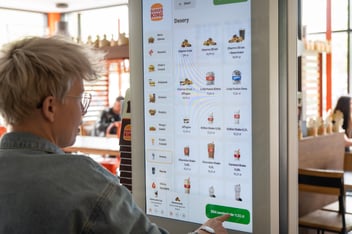
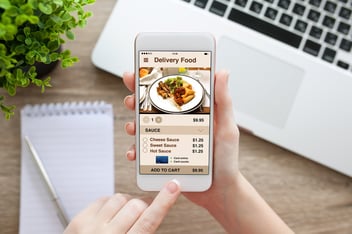
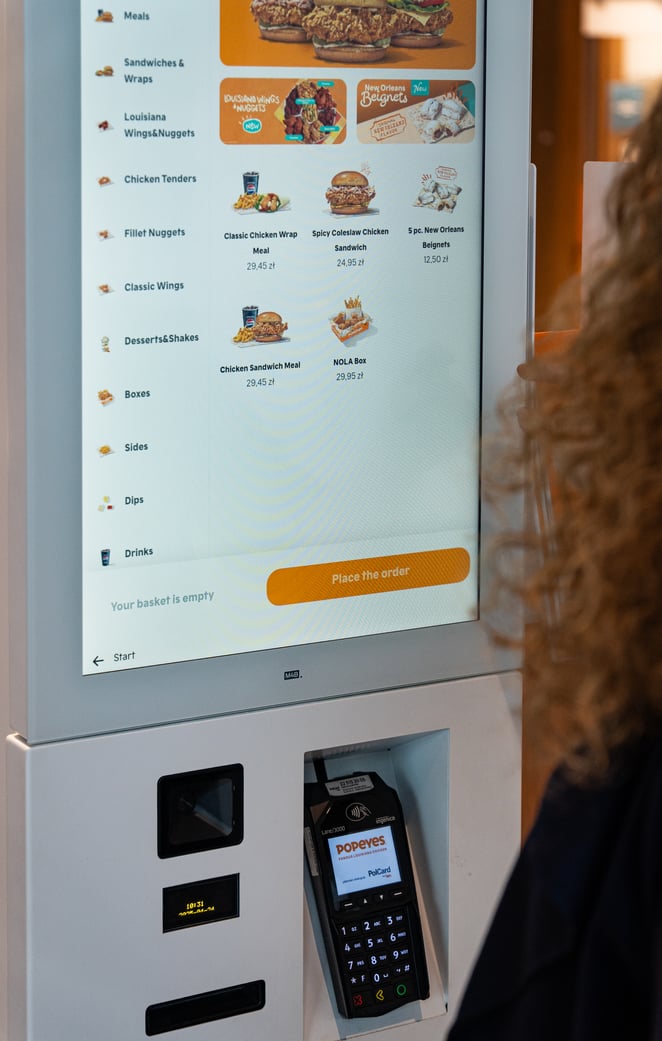
- Dynamic Menu Customization: Powered by machine learning, self-ordering kiosks and mobile apps in Quick Service Restaurants (QSRs) analyze past order history to instantly rearrange menus. The moment a guest logs in, the system highlights their favorite items or dietary preferences, creating a frictionless journey and faster ordering times.
- Advanced Voice and Drive-Thru Solutions: Conversational AI systems and sophisticated voice bots are revolutionizing the off-premise ordering experience. They are fully capable of taking complex, highly customized orders with higher accuracy than human operators — even during peak rush hours or in noisy outdoor environments — ensuring no call goes unanswered and drive-thru lanes stay clear.
- Empowering Human Hospitality: By automating transactions and handling repetitive data entry, AI frameworks free up staff from being anchored to a cash register or phone terminal. This empowers employees to focus entirely on genuine hospitality in the front of the house — ensuring dining rooms are clean, orders are accurate, and guests feel truly welcomed.
Ultimately, restaurant AI technology serves as an operational backbone that enhances human connection rather than replacing it.
Predictive analytics: AI in the restaurant industry back-of-house
One of the most powerful applications of AI in the restaurant industry is predictive forecasting, which completely transforms traditional back-of-house efficiency. By leveraging machine learning in Quick Service Restaurants and larger dining chains, the system analyzes historical sales data, weather forecasts, traffic patterns, and local events to predict exactly how much food needs to be prepped on any given day. This proactive approach removes the guesswork from kitchen management, allowing operators to align their prep sheets perfectly with anticipated consumer demand.
This level of accuracy drastically reduces food waste and ensures that high-margin items never run out of stock during peak rushes. By integrating these systems into the modern restaurant AI technology stack, kitchen managers can unlock several key operational advantages:
- Elimination of over-prepping through precise demand forecasting that constantly adapts to external variables.
- Maximized profitability by keeping high-demand menu items continuously available without overstocking perishable goods.
- Real-time backend insights that can inform a dynamic pricing algorithm for menus to help move inventory before it expires.
Beyond daily preparation, AI also automates inventory management by placing purchase orders with suppliers automatically when stock levels reach a digitally calculated threshold. Through seamless artificial intelligence POS integration, the system tracks every ingredient used in real time as customer orders are placed. This automated restaurant inventory management process triggers reorders without requiring manual intervention, ensuring the kitchen remains fully operational while preventing capital from being tied up in excess supply.
Dynamic Pricing and Automated Upselling
Just as airlines and ride-sharing apps adjust prices based on real-time demand, an AI restaurant powered by Ordering Stack can seamlessly implement sophisticated operational strategies. By replacing rigid digital displays with context-aware, data-driven automation, the platform transforms a traditional static menu into a living, responsive business tool.
The core capabilities of this ecosystem can be broken down as follows:
|
Strategy |
Real-Time Triggers & Inputs |
Business Impact & Guest Benefits |
|
Dynamic Pricing |
• Peak hours • Kitchen capacity • Current foot traffic • Perishable inventory • Overarching market trends |
• Maximizes margins during high-demand periods. • Reduces waste by offering automatic discounts to move inventory quickly. • Allows the menu to automatically react to restaurant capacity. |
|
Automated Upselling & Cross-selling |
• Historical transaction data • Specific time of day • Current weather conditions • Exact cart composition |
• Increases average order value via intelligent algorithms. • Delivers targeted, personalized prompts instead of generic recommendations. • Optimizes the check size at the exact moment of purchase. |
This level of automation is fully realized through Ordering Stack’s smart menu management system. The platform automatically displays these high-converting cross-selling prompts across self-service kiosks, mobile apps, and web ordering screens.
Ultimately, this technology delivers a powerful dual benefit for the brand:
- A seamless guest experience through AI that makes ordering intuitive and tailored.
- A highly optimized revenue engine that consistently drives profitability without adding any friction to the counter.
Integrating AI into the digital spine
A successful AI implementation relies entirely on a unified single source of truth. Artificial intelligence cannot function effectively if the point of sale, kitchen display systems, and third-party delivery aggregators remain siloed in separate, isolated software ecosystems. Platforms like Ordering Stack serve as this critical digital spine, instantly connecting the core AI engine with your POS, KDS, and self-service kiosks to ensure operational data flows without friction across the entire enterprise. Without this foundational artificial intelligence POS integration, even the most advanced tools cannot access the real-time insights they need to optimize your business.
The digital spine of a modern Quick Service Restaurant feeds live data directly into the restaurant AI technology stack, allowing the system to make smart, autonomous adjustments on the fly based on actual kitchen conditions. Instead of relying on static estimates, the connected ecosystem responds dynamically to the pulse of the restaurant.
This interconnected approach enables the system to handle daily operational hurdles automatically:
- Automatically increasing estimated delivery times on third-party marketplace apps the moment the KDS reports that the kitchen line is backed up.
- Dynamically throttling incoming digital order volume during unexpected peak rushes to prevent staff burnout and protect food preparation quality.
- Syncing real-time item availability across all online menus instantly when automated restaurant inventory management detects a specific ingredient shortage.
By bridging the gap between back-of-house reality and front-of-house expectations, this integrated approach ensures that machine learning in Quick Service Restaurants works to actively solve daily bottlenecks. When every component of the business communicates through a single digital spine, operators can eliminate friction, protect their brand reputation from negative reviews, and truly deliver a seamless guest experience through AI.
Summary: the intelligent future of dining
Transitioning into an AI restaurant represents the ultimate step in digital transformation for 2026, marking a definitive shift from basic automation to true operational intelligence. By implementing an AI-ready ecosystem through Ordering Stack, Quick Service Restaurants can completely future-proof their operations, effortlessly turning raw transaction data into actionable profitability across every digital and physical channel. Ultimately, the brands that win in this competitive landscape will be those that leverage restaurant AI not merely as a tool to cut costs, but as a strategic means to elevate the customer journey and empower their frontline staff. Serving as the invisible manager that never sleeps, artificial intelligence is constantly calculating the most efficient way to run your backend business, allowing your team to step away from the screens and focus entirely on what matters most: the food and the guest.
FAQ
Does Ordering Stack support AI integrations for Quick Service Restaurants?
Yes. Ordering Stack serves as the critical digital spine and communication hub for enterprise QSR networks. While it natively manages digital channels like self-service kiosks, mobile apps, and web ordering, its Unified Commerce architecture is built specifically to integrate with advanced AI tools.
By acting as an integration layer between your existing POS (such as Oracle Simphony, NCR Aloha, or SICOM) and backend kitchen systems, Ordering Stack allows operators to easily deploy AI-driven capabilities, including:
- Predictive upselling mechanics on kiosk and mobile screens to boost average order value.
- Real-time menu personalization based on live customer data and inventory levels.
- Automated throttling of external food aggregators (like UberEats or Glovo) when the kitchen is backed up.
Will restaurant AI eventually replace all human employees?
The short answer is no. The primary goal of restaurant AI is to eliminate operational friction, not human hospitality.
AI is designed to absorb repetitive, high-stress, and low-leverage tasks—like typing inbound drive-thru orders, calculating raw ingredient prep sheets, or manually triggering supplier purchase orders. By offloading these administrative bottlenecks to technology, human staff are finally freed to step out from behind the cash register. This allows teams to focus entirely on food quality, kitchen efficiency, and making guests feel genuinely welcomed in the dining room.
How expensive is it to implement AI in an independent restaurant?
Implementing AI is no longer a luxury reserved exclusively for multi-billion dollar enterprise chains.
Because modern technology platforms operate on cloud-based Software-as-a-Service (SaaS) models, independent restaurants can adopt AI features incrementally. You don't need to purchase multi-million dollar hardware or completely replace your current setup. Many sophisticated AI capabilities—such as smart menu cross-selling or automated inventory tracking—can be unlocked simply by layering smart middleware onto your existing, compatible POS network.
How does voice AI handle strong accents or complex order modifications?
Modern voice AI engines are a massive leap forward from the rigid, easily confused voice-recognition tools of the past.
Built specifically for high-stress environments like QSR drive-thrus, today's voice AI uses advanced Natural Language Processing (NLP) models trained on thousands of diverse, real-world speech patterns.
- Acoustic Filtering: The software isolates the speaker's voice, actively filtering out heavy background road noise, engine revs, and kitchen clatter.
- Semantic Understanding: Instead of searching for exact keyword matches, the AI reads sentences semantically. It easily understands regional accents, slang, and complex, multi-modifier requests (e.g., "Gimme a double cheeseburger, but hold the pickles, add extra bacon, and swap the regular fries for sweet potato").
Can AI really predict restaurant sales accurately?
Yes, and it does so with a level of precision that a human manager using a manual spreadsheet simply cannot match.
Traditional forecasting looks backward at what you sold on this date last year. AI predictive analytics, however, look at the whole picture in real time. The system synthesizes historical sales data alongside live external variables, including:
- Hyper-local weather forecasts (predicting a sudden drop in patio traffic).
- Real-time traffic congestion and construction patterns.
- Neighborhood event schedules (concerts, sports games, school holidays).
By analyzing these overlapping data points, the AI can predict exactly how much inventory to pull and how many staff members to schedule, regularly improving demand forecasting accuracy by up to 20%.
What are the privacy concerns regarding AI and customer data in restaurants?
As restaurants transition toward data-driven marketing, customer privacy, data storage security, and transparent consent have become major priorities. Because AI relies on order histories to personalize menus and loyalty rewards, operators face valid scrutiny over how that information is handled.
To address these concerns safely, modern AI integrations use secure data masking and tokenization. Customer payment information and personal identifying information (PII) are encrypted at the POS level. Order histories are often anonymized into broad behavioral patterns rather than tied to a specific individual’s identity, ensuring full compliance with local regulations like GDPR or CCPA while still maintaining a tailored guest experience.